Blog
-
Fact or Fiction?
Is there scope to write this as fiction especially if it’s to be for our children’s children? Certainly that approach lends itself to a little more poetic license. Or maybe a sister publication could emerge that’s fiction rather than fact? Food for thought…
-
Are the kids really alright?

Blue Sky Wondering if this can be a children’s book? Seems adults have written children’s books about climate change science especially. However, books like this may not have been aimed at kids.
Children are going to inherit our problems. Of course, problems and some solutions are well documented but all too often those solutions are rooted in the present.
What if we, as adults, look though the eyes of future adults: the children and their children’s children. How will they be able to respond to problems of their own days upon this fragile planet?
It’s certainly good to be ‘solutions oriented’. For instance, so many luminaries are proposing many interlinked crises are already occurring.
They’re then deriving corresponding solutions for today but, realistically, if the status quo only changes at a snail’s pace (between generations) then what do today’s solutions look like all those years ahead when they finally stand a chance of being enacted?
It’s not futurology to propose a future context for future solutions to current problems. It’s simply being real. That perspective may sadly be lacking in our jostling and jousting to be The One with all the answers. Let’s, for once, think about the kids and if they really are alright.
-
Mind Map (Of Sorts)!
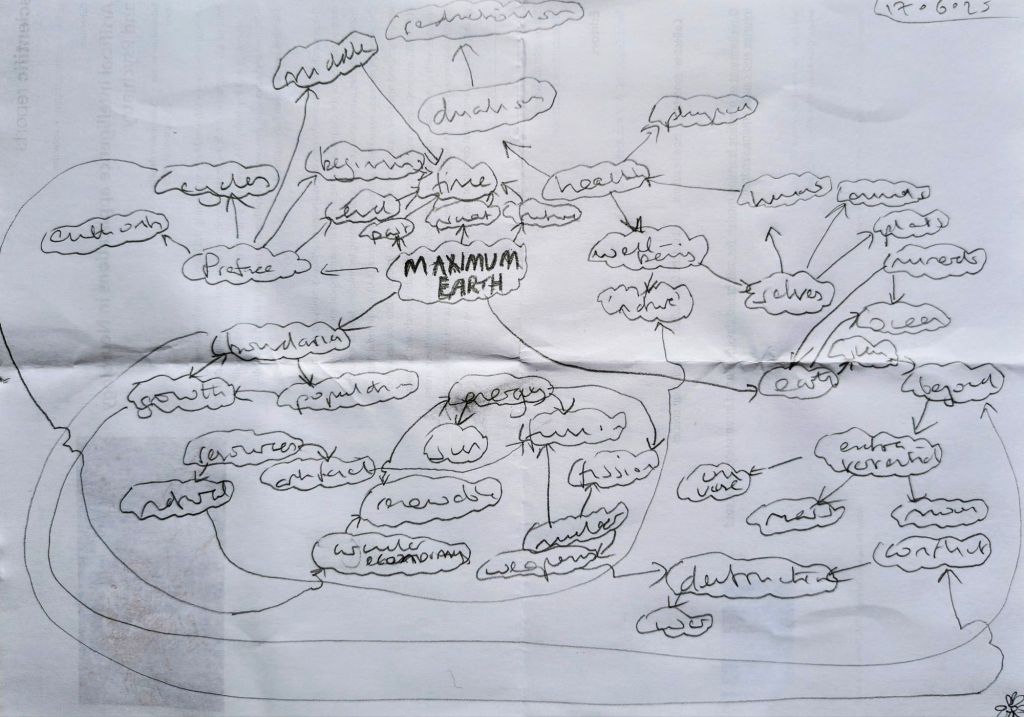
Here’s a kind of mind map of a few key ideas currently bouncing around my brain regarding this work. This now needs to be translated into a rough plan eventually leading to a Table of Contents. That’s no easy task given the breadth of concepts herein!
-
Start At The Beginning Or The End?

So, there’s now a (currently offline) preface (of sorts) for this – assuming it is to become another book length piece or at least borrow from that linear kind of structure.
It’s a quite personal account of being told by an ‘authority’ at that time of the need to finish what one starts. It’s prompting thinking about limits but there’s more to it than that.
In the context of this work we should certainly be mindful of limits to ‘natural resources’, for instance. However, there’s something central to that thinking that’s flawed. That is, the conceptualisation of a beginning and an end to phenomena is not always apt being especially dependent upon scale.
That’s not to say we can always act with impunity towards extraction of capital especially from Earth but that, if we are aware of those limits, it may be possible to work with them rather than against them?
There may be no beginning and there may be no end. Certainly, demarcating where something begins and ends can be problematic especially if causality is eschewed and again scale must be taken into account.
For example, if we’re to inhabit other planets in the future can we begin to state that we’ve naturally exhausted this one? In that case Maximum Earth may not be of concern.
Nature itself cycles. We cycle. Everything may go round and round. Perhaps, ultimately, it’s trying that counts whilst not being unduly concerned about beginning and ends.
-
Be Careful What You Wish For!
There’s preparedness and there’s tempting fate. We could reach such a level of anticipation that what we’re preparing for becomes inevitable. Economies, for instance, become dependent upon the production of ‘things’ for that eventuality which, ironically, we may have actually been trying to avoid all along! Economic momentum is a tricky beast to do business with as it tends to create powerful elements within our societies that strengthen their positions through exercising their raision d’être. These elements buy more and more power and influence resulting in development trajectories heading in one direction only with little chance of a u-turn. That is, until there’s a (often generational) sea change, a paradigm shift, especially leading societies away from self-destructive patterns of behaviour and towards those deemed more in-keeping with incoming ideologies. That begs the question of natural cycles generally observable throughout aspects of our realities. Those ‘things’ come and go in much the same way that forest fires cull older trees to allow the undergrowth to flourish. But, until (or in case ?) the fires begin to rage be careful what you wish for!
-
Water, water everywhere..?
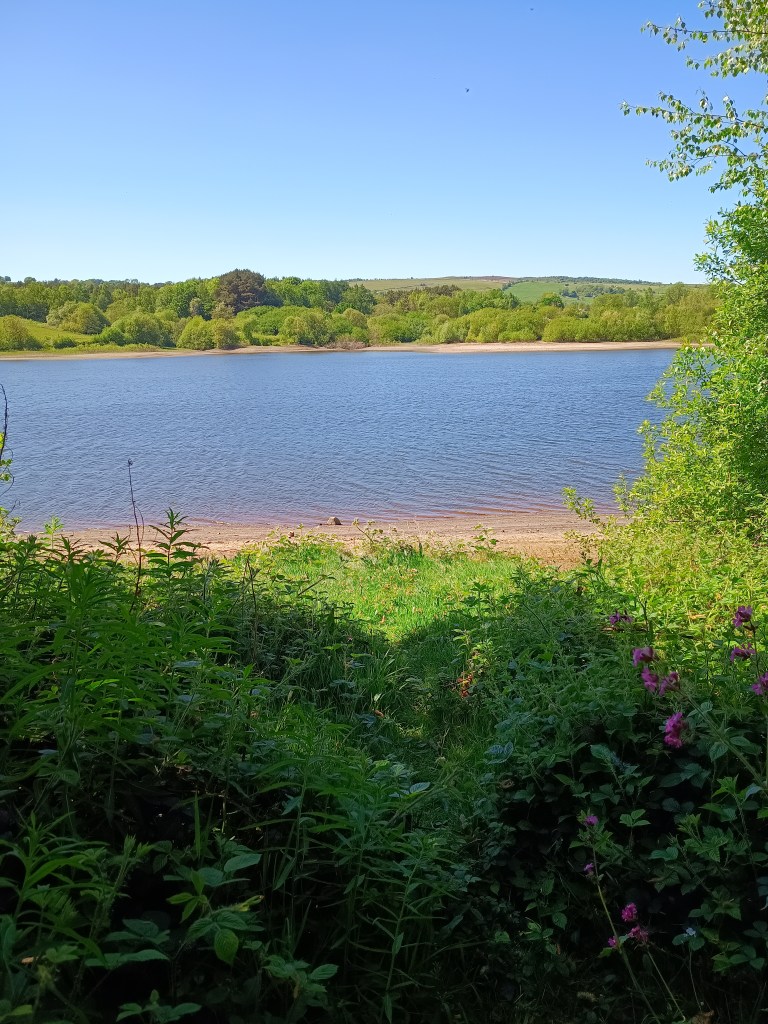
‘Natural resources’ are largely taken for granted by many members, institutions and enterprises in our societies. They’re usually viewed as a means of achieving our ends through processes of extraction. We may nurture them to help with these goals but ultimately seldom are they truly appreciated for their utility beyond production. That’s unfortunate given that if a deeper appreciation could be adopted perhaps we would be less extractive and more additive? That is, through an engagement with nature we can widen our understanding not only of our physical, outer world but also our spiritual, inner world. Through that kind of worldview we could begin to find peace with each other as nature finds peace – co-existence – with itself.
-
Versus
We don’t need to further the idea of this or that. We can instead accept both by looking for commonality and focussing on similarities not differences. By accepting ‘left’ or ‘right’ we are celebrating division. Division leads to hostilities. Hostilities, as mentioned, lead to war, suffering and ultimately self-destruction. There are many ideologies in the world that all too often are at odds with each other. Imagine an overarching theme that straddles all? Could we begin to work towards a true peace?
-
Power
Power, in both senses of the word, is fascinating. Often political considerations stymie challenges to the status quo by anything vaguely reminiscent of so-called ‘progressive’ ideals. That’s unfortunate yet understandable from a societal perspective. Too much rocking of the boat leads to it capsizing. Similarly, energy production and use is politicised to ensure that the status quo maintains it’s grip upon it’s raison d’être. Power for power. So, imagine trying to usurp the underlying structural basis of the construction of our societies to help work towards more just social outcomes by highlighting that a sea change in power is required to prevent the boat not only capsizing but completely sinking with all onboard. Yes, it’s almost impossible! 😁
-
Fight or Flight?
There may be little time left to begin to ensure we’re on a more sustainable development pathway. Furthermore, security is a bedrock of sustainable development. Without security all our efforts are undermined. Put simply, we either need to stop fighting now or throw in the towel on all our common futures on this planet and beyond.
 Maximum Earth
You must be logged in to post a comment.